Physician Spotlight: Dr. Mark Braunstein

A. Mark Braunstein, undefinedDr. Mark Braunstein is an orthopedist and surgeon with the Tucson Orthopaedic Institute in Tucson, Arizona, specializing in the hand and upper extremities.

Dr. Braunstein attended medical school in New Brunswick, New Jersey at Robert Wood Johnson Medical School, also completing his internship and residency at Robert Wood Johnson. He is board certified and fellowship trained in hand and upper extremity, completing his fellowship at Stony Brook Medical Center in New York before joining Tucson Orthopaedic Institute.

Dr. Braunstein’s specialty includes the entire arm, from shoulder to the fingertips. He is trained in the latest surgical techniques, such as arthroscopic and microsurgical procedures for the hand, wrist, elbow, and shoulder.  He works closely with each patient, helping them to understand the cause of their pain, and the best treatment going forward.

He has experience with rotator cuff tears and complete shoulder replacements, as well as more general orthopedic conditions such as bursitis, tendonitis, arthritis, and fracture care.

“The worst pain is from carpel tunnel syndrome…”, Dr. Braunstein recently stated at a lecture given at Green Valley Recreation’s East Center in 2015. Other common conditions of the upper extremities are “golfer’s elbow” (lateral epicondylitis) and De Quervain’s tenosynovitis, which is painful inflammation of the thumb tendons. Dr. Braunstein also treats patients with rheumatoid arthritis.

We are proud and privileged to have Dr. Braunstein working with us here at Tucson Orthopaedic. His expertise with the hand, wrist, elbow and shoulder is invaluable.  He provides both surgical and non-surgical treatments, and is committed to involving his patients in every part of their treatment to bring them back to a healthy, full and pain-free life.

If you are experiencing pain in your wrist or hand, or have had a recent injury to your elbow or shoulder, don’t hesitate to make an appointment with Dr. Braunstein today. He sees patients in our East office located at 5301 E. Grant Road, Tucson, AZ 85712.

Request an appointment online or call (520) 784-6200 to schedule a visit with Dr. Mark Braunstein.

Two Issues Reverse Shoulder Therapy May Help Eliminate

The shoulder joint is the most movable and complex joint in the body, therefore the opportunity for complex problems is greater. A few of the more common shoulder conditions are arthritis and rotator cuff injuries.  When both of these conditions are present, it can present a complex problem for the orthopedic surgeon. A relatively new FDA-approved procedure may be the answer:  reverse total shoulder replacement.

A brief review of shoulder anatomy

The shoulder joint is made up of three main bones; the collarbone (clavicle), the shoulder blade (scapula), and the upper arm bone (humerus). The shoulder joint is a ball-and-socket-type joint. The “socket” is a shallow dish-shaped area of the scapula. The top of the humerus bone is round like a ball, and fits into the socket.  The bones are held in place by the rotator cuff, which is made of four major muscles, tendons, and ligaments. The ligaments from the rotator cuff attach directly to the head of the humerus bone and hold the arm in place.

The shoulder joint is the most movable and complex joint in the body, therefore the opportunity for complex problems is greater. A few of the more common shoulder conditions are arthritis and rotator cuff injuries.  When both of these conditions are present, it can present a complex problem for the orthopedic surgeon. A relatively new FDA-approved procedure may be the answer:  reverse total shoulder replacement.

A brief review of shoulder anatomy

The shoulder joint is made up of three main bones; the collarbone (clavicle), the shoulder blade (scapula), and the upper arm bone (humerus). The shoulder joint is a ball-and-socket-type joint. The “socket” is a shallow dish-shaped area of the scapula. The top of the humerus bone is round like a ball, and fits into the socket.  The bones are held in place by the rotator cuff, which is made of four major muscles, tendons, and ligaments. The ligaments from the rotator cuff attach directly to the head of the humerus bone and hold the arm in place.

Rotator Cuff Tear and Arthritis

The shoulder can be injured easily at work, around the house, or during sports or exercise activities. When the cause of shoulder pain is related to your rotator cuff, the simple act of throwing a ball to your grandchild may cause enough pain to drop you to your knees.  In many cases minor rotator cuff injuries can be rehabilitated without surgery, but major damage must be surgically repaired.  In some cases, it may not be possible to fully restore the strength and stability of a damaged rotator cuff.

When your pain is caused by degeneration of soft tissues and the effects of arthritis inside the joint, you can thank the natural aging process. While Mild to moderate arthritis can be managed conservatively with medication, physical therapy, and therapeutic injections; severe arthritis can only be resolved by replacing the joint.

Traditional Vs Reverse Shoulder Replacement

In a traditional shoulder replacement, the ball of the humerus is replaced by a half ball, and the socket is replaced by a “cup”.  This mimics the same anatomy as the original bones, minus the arthritis.  If necessary, the rotator cuff is repaired and reattached to the new joint.  A traditional shoulder replacement is best for patients when the rotator cuff is intact or is repairable.

In a reverse shoulder replacement, the cup is placed on the top of the humerus – replacing the ball – and the ball is placed in the cup – replacing the socket.  See figure below. Reversing the ball and cup placement puts the deltoid muscle in place as the major muscle for the new joint instead of the rotator cuff. A reverse shoulder replacement is also recommended for people with severe arthritis and rotator cuff damage, or prior failed traditional shoulder replacement.  The reverse shoulder replacement procedure was approved by the FDA in 2004.

Am I a Candidate?

Through a comprehensive evaluation by your doctor which can include X-rays, and MRI, the doctors will determine which type of shoulder replacement is best suited for your case.  The extent of damage in your shoulder joint will determine the type of surgery you need.  People with unrepairable damage to their rotator cuff along with severe arthritis are the best candidates for reverse shoulder replacement.

It all starts with a visit to Tucson Orthopaedic Institute, Southern Arizona’s largest and most advanced multi-specialty orthopedic group.  Here, we are able to diagnose your symptoms to determine the best course of action for you. We can perform either a traditional or reverse shoulder surgery, and arrange your physical therapy so you can get back to doing all you like to do.

Several of our orthopedic surgeons are trained and experienced in both traditional and reverse shoulder replacement: Dr. Kevin Bowers and Dr. Christopher Stevens in the Oro Valley office, Dr. Joel Goode and Dr. Andrew Mahoney in the East office, and Dr. Steven Shapiro in the Northwest office.  Call one of our conveniently located offices today to schedule an appointment at Tucson orthopaedic Institute.
Helpful Tips for Post-Operative Elbow, Hand and Shoulder Surgery

You have just had hand surgery, elbow surgery, or shoulder surgery. These are some helpful hints and frequently asked questions that may help with your recovery and manage your pain.* By staying ahead of your pain and swelling, you do not have to catch up. Remember, an ounce of prevention is worth a pound of cure!

Pain Management

  • Begin taking prescription pain medication given to you the same day of your surgery, BEFORE you go to bed. If you have received a nerve block, there is a good chance you will still be comfortable before you go to bed. However, the block will eventually wear off. Take your pain medication before the block wears off/before you go to bed.
  • The pain can be more manageable if you stay ahead of your pain, and not chase your pain.
  • Itching is a side effect that is quite common to experience after using narcotic pain medication. If you are itching, try over-the-counter Benadryl as directed. This may help to alleviate the itching.
  • However, if you are having difficulty breathing, swelling of the lips, face and/or throat, or a new rash, this may indicate a serious allergic reaction. You should stop taking the medication and alert your doctor or seek prompt medication attention.
  • As for use of anti-inflammatory medication, such as ibuprofen, Aleve, Motrin, etc., after surgery, this depends on your physician preference. Please check on your discharge instructions or ask your physician before or at the time of your surgery.

Nausea/Constipation

  • It is also not uncommon to experience nausea, constipation and sometimes drowsiness with narcotic pain medications.
  • Nausea is a common side effect either from the anesthetic or from the pain medication prescription itself. Make sure you take the medication with food to help prevent nausea.
  • The medication can also slow down your gastrointestinal tract and lead to constipation. If you experience constipation, try eating foods with high fiber, prune juice, and/or over the counter stool softeners (Check with your local pharmacists about stool softeners, if you have any questions).
  • If these are happening, cut back on the amount of pain medication you are taking or stop taking the medication. Contact your physician.
  • Do not drive while you are taking pain medications. They may enable your full capacity. Do not drink alcohol, use illicit drugs, drive or make any important decisions while taking pain medication.

Swelling Control

  • Swelling is one of the things that contribute to your post-operative pain.
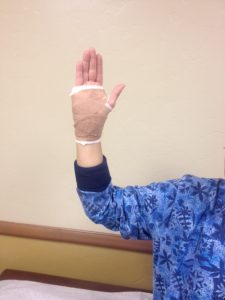
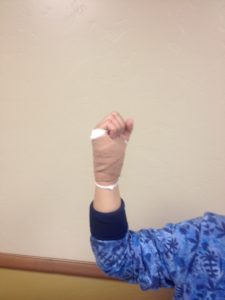
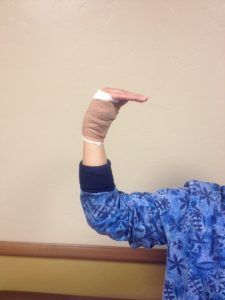
  • After your surgery, keep your hand elevated, unless specified not too.
  • If you have had shoulder surgery, elevation of your hand may be difficult. In this case, getting a squeeze ball and making a fist repetitively can help to pump the swelling away from your hand.
  • Elevate your hand above the level of your heart, especially 3-5 days after surgery.
  • Below are some photos showing correct ways to elevate your hand.
  • Ice is an excellent anti-inflammatory and helps control pain and swelling. Apply ice to the surgical site as tolerable (unless specified otherwise). If the discharge information specifies not to ice, then please do not do so. This may be the case in some situations.

Positions to elevate your hand following surgery:

Exercises/Therapy

  • If you have had surgery on your shoulder and/or wrist/hand, it is important to start exercises the day of surgery by making a full fist and straightening your fingers. However, if your surgery was to repair a broken finger, or specified otherwise, follow specific instructions given to you.
  • You may be referred to a formal therapist at your follow-up appointment or subsequent appointments. Therapy is determined by your health care provider and individualized for your specific case.

Dressing/Cast and Sling

  • Do NOT remove your dressing, unless you are told to do so. This will be removed and/or changed at your first post-operative visit. Keep bandage clean and dry.
  • Do NOT get your dressing wet. Protect it with a plastic bag when you shower.
  • If your dressing is too tight, you may loosen the ace/bandage, and split the dressing down on one side; however, do NOT remove the entire dressing/splint.
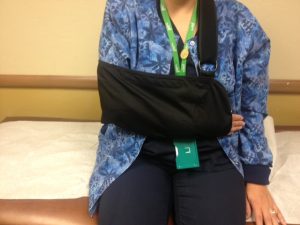
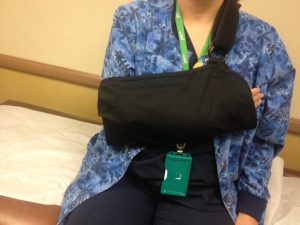
  • If you are placed in a sling for a shoulder surgery, keep arm in the sling (as pictured below). Do not actively move the operative shoulder, unless told otherwise. You may gently move your hand, wrist and elbow.
  • Seeing blood on or through your bandage occurs and should not be worrisome unless excessive and expanding. You can try to apply some pressure to the area or reinforce the dressing to prevent further bleeding. If excessive and does not stop, call your physician or seek medical attention.
  • If you dressing is off, and while your incision is healing, please refrain from applying any antibiotic cream or ointment to the incision area. Keep clean and dry. Regular antimicrobial soap and water while washing is preferred.

Correct placement of arm sling following shoulder surgery:

Long-Term Management and Expectations

  • After a traumatic injury and/or elective surgery, it is common to experience swelling for several months. Typically, the process will gradually improve over the next 12 months! Try not to get discouraged, because the swelling will most likely improve with time.
  • As time progresses after surgery, the amount of activity will be determined by your physician/health care provider.

*There are many surgeries that are performed on the upper extremity (including surgeries for rotator cuff tear, carpal tunnel syndrome, and trigger finger) with many different post-operative instructions. The information above may not always pertain to you if you were told otherwise on your discharge paperwork and/or by your physician.

Written by Joel R. Goode, MD and Lauren King, PA-C, with contributions by Liz Cakmarstitt, MA

Prickett on Becker’s List of 65 Outstanding Shoulder Surgeons and Specialists

Chicago – Becker’s Orthopedic, Spine & Pain Management Review is pleased to announce the inclusion of Dr. William Prickett on its list: “65 Outstanding Shoulder Surgeons and Specialists”. The physicians on this list were selected based on their expertise in shoulder surgery, leadership positions, excellent research and reputation among other shoulder specialists. The editorial team publicly solicited recommendations for this list and chose additional physicians through extensive internal research. Physicians do not pay and cannot pay for inclusion on this list.

William D. Prickett, MD (Tucson Orthopaedic Institute)

Dr. Prickett has clinical and research interests in sports medicine and shoulder surgery. He has authored several articles on topics such as shoulder instability in athletes. Dr. Prickett earned his medical degree at Emory University School of Medicine in Atlanta and completed his orthopedic surgery residency at Washington University Medical Center in St. Louis. His additional training includes a sports medicine and shoulder service fellowship at the Hospital for Special Surgery in New York City. He has also spent time working with the New York Giants. During his career, he has given several presentations at professional meetings of the American Academy of Orthopaedic Surgeons and American Shoulder and Elbow Surgeons.

The Becker’s editorial team devised the list after extensive research and public solicitation for outstanding candidates. The list was also vetted through shoulder specialists from around the country before finalization. Members of the list are often leaders of their groups, winners of prestigious research awards and team physicians for professional athletes. Each member of the list underwent rigorous review before inclusion as an outstanding specialist in the field of shoulder surgery.

We congratulate each physician selected for inclusion on this list. If you would like to learn more about this list or future lists slated for publication in Becker’s Orthopedic, Spine & Pain Management Review, please contact assistant editor Laura Miller at laura@beckersasc.com.

Becker’s Orthopedic, Spine & Pain Management Review is an online and print publication with a target audience of physicians, group leaders and industry experts. The online publication receives more than 147,000 pageviews per month and the print publication circulates four times per year. The publication also sends out free electronic newsletters twice weekly.

Search

+