
Tucson Orthopaedic surgeon helps new hip replacement procedure

Source: KVOA 4 Your Health published on August 22, 2016

Written by John Overall

TUCSON – The first hip replacement surgery was performed in 1960. Now, more than 300,000 total hip replacements are performed each year in the United States.

Dr. Russell Cohen from the Tucson Orthopaedic Institute joined a team of other surgeons to develop a new surgical technique that allows their patients to get back on their feet sooner.

59-year-old Mindy Sparks suffers from severe arthritis in her hips. About six months ago the pain became unbearable, “I would walk across a parking lot and almost feel like crying it hurt so badly,” Sparks said.

Dr. Cohen showed News 4 Tucson Mindy’s X-Rays, “You can see here that her hip joint is completely gone. There’s no separation between the ball and the socket. So these two hips are about as bad as a hip needs to be before we recommend it be replaced,” Dr. Cohen said.

Dr. Cohen has been performing minimally invasive hip and knee replacements since 2003. About three years ago Dr. Cohen joined six other surgeons and came up with a procedure they call The Direct Superior Approach to the hip.

Most surgeons make an incision along the femur bone, cutting into the Iliotibial Band which causes pain and requires more recovery time.

“The Direct Superior Approach stays at the very upper end of that incision so we come down to the top of the femur bone but we don’t go into the I-T band,” said Dr. Cohen.

Since the I-T band isn’t compromised and fewer muscles are disrupted, patients like Mindy experience less pain, less bleeding and fewer restrictions when they’re released from the hospital.

“Traditional hip patients are told don’t cross your legs, don’t bend past 90 degrees, watch out for dislocation, all these things. Well, I don’t do that anymore, I haven’t for quite some time,” Dr. Cohen said.

Sparks says she bounced right back after surgery, “It was easy, it was easy in the hospital. I felt better in the hospital instantly. They had me up and walking that day.”

Mindy started physical therapy the day after having her left hip replaced.  Three weeks later she’s walking much easier and looking forward to having her right hip replaced in a few weeks.

Dr. Cohen and his team are now traveling around the world teaching the Direct Superior Approach to other surgeons.

To learn more, visit the Tucson Orthopaedic Institute 4 Your Health page.
Introduction to Spine Care

The care of patients with spinal disorders has become increasingly complex. As a result, more health care providers have become involved in caring for these patients. The spectrum of providers is wide and includes operative, nonoperative, and pain management specialists. This complexity has lead to increasing frustration and confusion for patients. The objective of this article is to introduce the individuals involved in treating spinal conditions and their role in the treatment of these conditions.

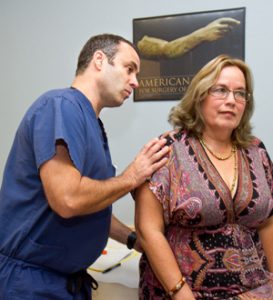
TOI-shots of doctors with patients

The first health care provider most patients will encounter for a back or neck problem is their primary care physician. It is his/her role to provide an initial examination and base his/her treatment on these findings. Typically, anti-inflammatory, pain and muscle relaxant medications will be recommended. Activity modifications (avoid excessive lifting, bending, twisting and turning) may also be recommended.

Physical therapists play an early, integral role in the treatment of patients with spinal conditions. They follow spine-based rehabilitation protocols depending on the patient’s diagnosis. A patient’s response to conservative treatment will often influence whether they will be referred to a specialist. Fortunately, most spinal conditions will resolve after approximately six weeks of conservative care.

During the treatment of spinal conditions, some patients will be referred for cortisone injections (epidural injections, nerve blocks, facet blocks) in order to alleviate their pain. Several different types of physicians perform these injections including anesthesiologists, physiatrists, and some surgeons.

Injections are an integral part of the treatment of this subset of patients. The injections provide diagnostic information (localizing the pain source) and will hopefully provide therapeutic (long-term) relief. The injections are not intended to remove arthritis from the spine or spinal canal or cause disk herniations to resorb. The objective of the cortisone injection is to reduce inflammation in the affected area resulting in pain relief.

For those patients who do not respond to nonoperative treatment, surgery may be recommended. One common question patients have is, “Who should perform my spine surgery: an orthopaedic surgeon or a neurosurgeon?” Patients should seek out those surgeons whose predominate field of expertise is spinal surgery. This person typically has advanced training in and dedicates the vast majority of their elective operative cases to the practice of spinal surgery.

There are certain clinical circumstances (deformity, spinal cord tumors) that are treated exclusively by either an orthopaedic surgeon or a neurosurgeon; however, these represent a small percentage of cases. A spine surgeon will be able to treat conditions of the cervical, thoracic, and lumbar spine and will be well versed with complex spinal instrumentation.

Written by Steven Zeiller, MD

Search

+