Bisphosphonate Femur Fractures: An Ounce of Prevention is Worth a Pound of Cure

Written by: Ali Dalal, MD

view post on original source – LinkedIn

7/17/2016- Bisphosphonates (BPs) are a revolutionary class of medicines that can preserve bone health and prevent fractures caused by osteoporosis. They go by the trade names of Boniva™, Fosamax™, and Reclast™ among others. They have been shown to decrease spine fractures by 40-70% and hip fractures by 20-50%. They are truly life changing treatments when one considers that 1 in 3 women and 1 in 5 men will experience an osteoporotic fracture after the age of 50.

Like all medicines, BPs have side effects. One especially fearsome side effect of BP treatment is atypical femur fracture (AFF). AFFs are fractures caused by BPs. They are characterized by aching pain in the thigh or groin with weight bearing. They are easily visible on x-rays in their early stages and are much easier to treat before they become complete fractures. To be clear, AFFs are very rare and bisphosphonates most definitely prevent more fractures than they cause. However, the prolonged course of healing and the unpredictable nature of AFFs have caused great concern among patients and the media. A link between the number of years BPs are taken and the risk of AFF has been established. A task force of leading bone doctors and scientists has provided guidelines in 2016 on how to prevent AFFs based on individual patient risk factors. The guidelines are as follows:

Post-menopausal women treated with oral (pill form) bisphosphonates for 5 continuous years or intravenous (IV) bisphosphonates for 3 continuous years should be re-evaluated. If they have not had an osteoporotic fracture during treatment with the medicine (hip, spine, wrist, shoulder fracture), do not have osteoporosis on a DEXA scan (bone mineral density test) and are not considered to be a “high fracture risk” based on age and other factors, they should consider a temporary stoppage of medicine or a “drug holiday” for 2-3 years.  After this time period they should be re-evaluated. The drug holiday allows some of the potential harmful effects of BPs to decrease.

As you can tell, the guidelines are not simple. As a doctor I had to read it a few times before it sank in.  Stopping or continuing the medicine requires significant judgment on the part of the doctor prescribing it. These medicines should not be stopped without a consultation with the prescribing doctor. As a patient, the important thing to take away is that if you have been on these medicines for years and are experiencing the symptoms of AFFs, don’t ignore them. AFFs are much easier to treat in the early stages. Secondly, if you have been taking these medicines for years but haven’t seen the prescribing doctor in a while, it might be time to find out where you stand in terms of your risk. With AFFs, an ounce of prevention is worth a pound of the cure.

  1. Adler et al. Managing Osteoporosis in Patients on Long-Term Bisphosphonate Treatment: Report of a Task Force of the American Society for Bone and Mineral Research. Journal of Bone and Mineral Research. Volume 31, Issue 1, pages 16–35, January 2016
Anterior Hip Replacement – What Is It All About?

Our joint replacement surgeons are often asked about the latest developments in arthritis surgery. With the advent of minimally invasive techniques in orthopedic surgery, joint surgeons at Tucson Orthopaedic Institute (TOI) are performing hip replacement through the front (anterior) of the hip as opposed to the more traditional posterior, or backside approach. TOI physicians currently using this approach with some patients are Kevin W. Bowers, MD, and Edward P. Petrow, Jr., DO.

The logic behind anterior hip replacement is to try to minimize muscle damage by working through the natural intervals between muscles to gain access to the front of the hip, as opposed to detaching and repairing the muscles to gain access to the hip joint from behind. However, some questions still remain relating to the anterior approach.

Is anterior hip replacement a new technique?

No. The anterior hip approach was first described by Smith-Petersen in 1917. It was used by the French surgeon, Robert Judet, in 1947 to perform an isolated femoral head replacement. This later evolved into other French surgeons performing complete hip joint replacements through an anterior exposure in the 1960s.

Why all the interest if this technique has been in existence since the 1960s?

Early surgeons found that the visualization of the hip socket was excellent through the front of the hip; however, it was very difficult to insert a long straight metal stem down the femur through an anterior approach. If complications occurred during surgery, it was very difficult to change or extend the anterior approach to overcome difficult surgeries and provide for better visualization. Therefore, most surgeons opted to perform hip replacement through posterior, or posterior and lateral (anterolateral) exposures.

The posterior approach has become the most popular way to perform hip replacement since that time. However, the posterior approach has historically been associated with a higher dislocation rate, while the anterolateral method can leave the repaired muscle weaker and can cause a limp as compared to replacements performed through the front of the hip.

By using specialized instrumentation, newer generation hip implants, a custom operating table, and real-time intra-operative X-ray equipment, anterior hip replacement has made a resurgence. These additions have allowed the anterior approach to become easier and more reliable to perform than before.

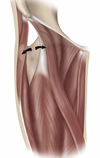
Figure 1.0
Muscles parted for
access to hip joint.

What are the benefits of anterior hip replacement?

Since anterior total hip replacement does not require the detachment or splitting of any muscles about the hip, thus preserving muscle strength, patients report less pain as well as a quicker return of function after surgery (see Figure 1.0).

Richard Murlless, a 65-year-old Sahuarita resident, found this to be true after undergoing anterior hip replacement in February with Dr. Petrow. Murlless could bear weight and walk, using a walker, within the first week following surgery. Murlless explains that soon after surgery he had “less pain than what I was suffering before surgery.”

Murlless opted to wait until a new surgical table was available at the hospital to have his hip replaced because he did not want to be “incapacitated” for several months with the conventional approach. Both Dr. Petrow and Dr. Bowers, who uses this special operating table and real-time intra-operative X-rays, have the ability to position the replaced hip components more accurately and reproduce the hip’s natural anatomy (see Figure 2.0).

For example, the table is designed to allow extension of a patient’s leg downward, which gives frontal access to the hip that is not possible with conventional tables. It also allows the use of intra-operative X-ray, which gives a more accurate recreation of the patient’s leg length.

Figure 2.0
Operating table developed for anterior hip surgical technique.
 
Lastly, since the hip is reconstructed through the front without destabilizing the structures on the back of the joint, there does not appear to be any reason to place patients on routine hip precautions post-operatively, such as limited hip motion for 6-8 weeks.Murlless began his rehabilitation quickly following surgery and recovered nearly 100% of his previous range of hip motion after 4 sessions of physical therapy. He says his progress is on par with others who have received this procedure, but those who he has spoken to are impressed. Since surgery, 7 weeks have passed and he now considers himself fully recovered and pain-free.Dorothy Krieger, of Saddlebrooke, Arizona, had a similar experience in her recovery following anterior THA back in March. Krieger felt her left hip was “unreliable” and eventually she was unable to walk because of constant pain. When discussing with friends, they were confident in Dr. Bowers’ skills and gave encouraging testimonials for this procedure. Krieger said those comments were the “driving force behind my decision to have surgery.”

The 62-year-old underwent anterior total hip replacement on March 2 and was able to walk without an assistive device after one week; then she completed physical therapy 4 weeks after that. Krieger says she is happy with the result and is able to enjoy activities again, like hiking.

What hip approach is recommended?

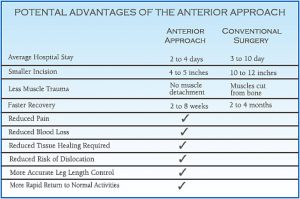
Since every hip exposure has specific pros and cons (see Figure 3.0), it is recommended to discuss your options with your surgeon. It is the job of the surgeon to match each individual patient’s need to the specific approach. Patients and surgeons want to minimize pain and speed recovery, yet the main objective of hip replacement is to provide patients with a well done operation, with good component position, and the expectation that it will last for the next 20 years.

Figure 3.0  Advantages associated with the anterior approach compared to conventional surgery.

Search

+