Two Issues Reverse Shoulder Therapy May Help Eliminate

The shoulder joint is the most movable and complex joint in the body, therefore the opportunity for complex problems is greater. A few of the more common shoulder conditions are arthritis and rotator cuff injuries.  When both of these conditions are present, it can present a complex problem for the orthopedic surgeon. A relatively new FDA-approved procedure may be the answer:  reverse total shoulder replacement.

A brief review of shoulder anatomy

The shoulder joint is made up of three main bones; the collarbone (clavicle), the shoulder blade (scapula), and the upper arm bone (humerus). The shoulder joint is a ball-and-socket-type joint. The “socket” is a shallow dish-shaped area of the scapula. The top of the humerus bone is round like a ball, and fits into the socket.  The bones are held in place by the rotator cuff, which is made of four major muscles, tendons, and ligaments. The ligaments from the rotator cuff attach directly to the head of the humerus bone and hold the arm in place.

The shoulder joint is the most movable and complex joint in the body, therefore the opportunity for complex problems is greater. A few of the more common shoulder conditions are arthritis and rotator cuff injuries.  When both of these conditions are present, it can present a complex problem for the orthopedic surgeon. A relatively new FDA-approved procedure may be the answer:  reverse total shoulder replacement.

A brief review of shoulder anatomy

The shoulder joint is made up of three main bones; the collarbone (clavicle), the shoulder blade (scapula), and the upper arm bone (humerus). The shoulder joint is a ball-and-socket-type joint. The “socket” is a shallow dish-shaped area of the scapula. The top of the humerus bone is round like a ball, and fits into the socket.  The bones are held in place by the rotator cuff, which is made of four major muscles, tendons, and ligaments. The ligaments from the rotator cuff attach directly to the head of the humerus bone and hold the arm in place.

Rotator Cuff Tear and Arthritis

The shoulder can be injured easily at work, around the house, or during sports or exercise activities. When the cause of shoulder pain is related to your rotator cuff, the simple act of throwing a ball to your grandchild may cause enough pain to drop you to your knees.  In many cases minor rotator cuff injuries can be rehabilitated without surgery, but major damage must be surgically repaired.  In some cases, it may not be possible to fully restore the strength and stability of a damaged rotator cuff.

When your pain is caused by degeneration of soft tissues and the effects of arthritis inside the joint, you can thank the natural aging process. While Mild to moderate arthritis can be managed conservatively with medication, physical therapy, and therapeutic injections; severe arthritis can only be resolved by replacing the joint.

Traditional Vs Reverse Shoulder Replacement

In a traditional shoulder replacement, the ball of the humerus is replaced by a half ball, and the socket is replaced by a “cup”.  This mimics the same anatomy as the original bones, minus the arthritis.  If necessary, the rotator cuff is repaired and reattached to the new joint.  A traditional shoulder replacement is best for patients when the rotator cuff is intact or is repairable.

In a reverse shoulder replacement, the cup is placed on the top of the humerus – replacing the ball – and the ball is placed in the cup – replacing the socket.  See figure below. Reversing the ball and cup placement puts the deltoid muscle in place as the major muscle for the new joint instead of the rotator cuff. A reverse shoulder replacement is also recommended for people with severe arthritis and rotator cuff damage, or prior failed traditional shoulder replacement.  The reverse shoulder replacement procedure was approved by the FDA in 2004.

Am I a Candidate?

Through a comprehensive evaluation by your doctor which can include X-rays, and MRI, the doctors will determine which type of shoulder replacement is best suited for your case.  The extent of damage in your shoulder joint will determine the type of surgery you need.  People with unrepairable damage to their rotator cuff along with severe arthritis are the best candidates for reverse shoulder replacement.

It all starts with a visit to Tucson Orthopaedic Institute, Southern Arizona’s largest and most advanced multi-specialty orthopedic group.  Here, we are able to diagnose your symptoms to determine the best course of action for you. We can perform either a traditional or reverse shoulder surgery, and arrange your physical therapy so you can get back to doing all you like to do.

Several of our orthopedic surgeons are trained and experienced in both traditional and reverse shoulder replacement: Dr. Kevin Bowers and Dr. Christopher Stevens in the Oro Valley office, Dr. Joel Goode and Dr. Andrew Mahoney in the East office, and Dr. Steven Shapiro in the Northwest office.  Call one of our conveniently located offices today to schedule an appointment at Tucson orthopaedic Institute.
New Minimally Invasive Partial Knee Resurfacing: Relieve Osteoarthritis Pain Using Robotic Arm Technology

Everyday I come across patients who are suffering from joint pain in their knee due to osteoarthritis. I am frequently asked about the latest treatment techniques that may offer faster recovery. One procedure that can relieve pain is a minimally invasive technique for partial knee resurfacing. Below are some frequently asked questions about this new procedure.

What is osteoarthritis?

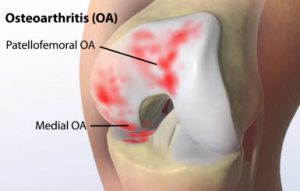
Osteoarthritis (OA), or degenerative joint disease, is characterized by the breakdown and eventual loss of joint cartilage. Cartilage is a substance that serves as the “cushion” for our joints. As the cartilage wears away, eventually the bone is exposed. Severe OA is characterized by “bone-on-bone” changes. Symptoms of OA of the knee include: 

  • Pain with activities such as standing, walking, stair climbing, or getting up from a chair
  • Start up pain or stiffness when activities are initiated from a sitting position
  • Joint stiffness after getting out of bed
  • Swelling in one or more areas of the knee
  • A grating sensation or crunching feeling in the knee during use

How do you treat osteoarthritis?

Symptoms are always treated non-surgically first, but when those solutions fail, total knee arthroplasty is an effective procedure to deal with the pain and disability associated with arthritis in the knee. Approximately 600,000 total knee replacements are performed annually in the United States. A subset of these patients (perhaps 10-30%) may be candidates for a partial knee replacement or unicompartmental replacement. In this procedure, only the affected portion of the knee is replaced leaving the rest of the intact and functioning knee joint in place.

What is the advantage of a partial knee replacement?
The advantages of this procedure, compared to a total knee replacement, are a quicker functional recovery, smaller incisions, less hospitalization and perhaps a more “natural” feel to the operated knee.

Are there any downsides?

Historically, the unicompartmental knee replacement has been a very technically challenging procedure. Small alignment errors may contribute to failure of the procedure.

What advancements have been made in this procedure?

MAKOplasty is the next evolution in unicompartmental knee replacement. In MAKOplasty, a 3-dimensional CT scan of the patient’s leg is obtained. This data is placed into the RIO – Robotic Arm Interactive Orthopedic System pre-operatively. The surgeon then uses 3-dimensional computer modeling to plan the surgery and uses the robotic arm during surgery to complete the plan with great accuracy. The MAKOplasty system also allows for intra-operative adjustments.

What have the results been?

The MAKOplasty procedure is an exciting advancement in partial knee replacement. Studies have shown that it increases the accuracy of the procedure 2-3 times compared to standard techniques. The improved precision of the surgery should lead to better patient outcomes in the short and long term.

Where is it performed?

In Tucson, the procedure is only available at Oro Valley Hospital and is performed by specially trained orthopaedic surgeons.

If you have knee pain well localized to one are of the knee, you may be a candidate. Call the Tucson Orthopaedic Institute in Oro Valley to schedule a consultation with Dr. Bowers.

By Kevin W. Bowers, MD

Anterior Hip Replacement – What Is It All About?

Our joint replacement surgeons are often asked about the latest developments in arthritis surgery. With the advent of minimally invasive techniques in orthopedic surgery, joint surgeons at Tucson Orthopaedic Institute (TOI) are performing hip replacement through the front (anterior) of the hip as opposed to the more traditional posterior, or backside approach. TOI physicians currently using this approach with some patients are Kevin W. Bowers, MD, and Edward P. Petrow, Jr., DO.

The logic behind anterior hip replacement is to try to minimize muscle damage by working through the natural intervals between muscles to gain access to the front of the hip, as opposed to detaching and repairing the muscles to gain access to the hip joint from behind. However, some questions still remain relating to the anterior approach.

Is anterior hip replacement a new technique?

No. The anterior hip approach was first described by Smith-Petersen in 1917. It was used by the French surgeon, Robert Judet, in 1947 to perform an isolated femoral head replacement. This later evolved into other French surgeons performing complete hip joint replacements through an anterior exposure in the 1960s.

Why all the interest if this technique has been in existence since the 1960s?

Early surgeons found that the visualization of the hip socket was excellent through the front of the hip; however, it was very difficult to insert a long straight metal stem down the femur through an anterior approach. If complications occurred during surgery, it was very difficult to change or extend the anterior approach to overcome difficult surgeries and provide for better visualization. Therefore, most surgeons opted to perform hip replacement through posterior, or posterior and lateral (anterolateral) exposures.

The posterior approach has become the most popular way to perform hip replacement since that time. However, the posterior approach has historically been associated with a higher dislocation rate, while the anterolateral method can leave the repaired muscle weaker and can cause a limp as compared to replacements performed through the front of the hip.

By using specialized instrumentation, newer generation hip implants, a custom operating table, and real-time intra-operative X-ray equipment, anterior hip replacement has made a resurgence. These additions have allowed the anterior approach to become easier and more reliable to perform than before.

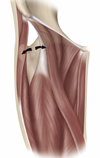
Figure 1.0
Muscles parted for
access to hip joint.

What are the benefits of anterior hip replacement?

Since anterior total hip replacement does not require the detachment or splitting of any muscles about the hip, thus preserving muscle strength, patients report less pain as well as a quicker return of function after surgery (see Figure 1.0).

Richard Murlless, a 65-year-old Sahuarita resident, found this to be true after undergoing anterior hip replacement in February with Dr. Petrow. Murlless could bear weight and walk, using a walker, within the first week following surgery. Murlless explains that soon after surgery he had “less pain than what I was suffering before surgery.”

Murlless opted to wait until a new surgical table was available at the hospital to have his hip replaced because he did not want to be “incapacitated” for several months with the conventional approach. Both Dr. Petrow and Dr. Bowers, who uses this special operating table and real-time intra-operative X-rays, have the ability to position the replaced hip components more accurately and reproduce the hip’s natural anatomy (see Figure 2.0).

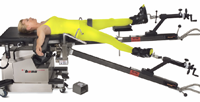
For example, the table is designed to allow extension of a patient’s leg downward, which gives frontal access to the hip that is not possible with conventional tables. It also allows the use of intra-operative X-ray, which gives a more accurate recreation of the patient’s leg length.

Figure 2.0
Operating table developed for anterior hip surgical technique.
 
Lastly, since the hip is reconstructed through the front without destabilizing the structures on the back of the joint, there does not appear to be any reason to place patients on routine hip precautions post-operatively, such as limited hip motion for 6-8 weeks.Murlless began his rehabilitation quickly following surgery and recovered nearly 100% of his previous range of hip motion after 4 sessions of physical therapy. He says his progress is on par with others who have received this procedure, but those who he has spoken to are impressed. Since surgery, 7 weeks have passed and he now considers himself fully recovered and pain-free.Dorothy Krieger, of Saddlebrooke, Arizona, had a similar experience in her recovery following anterior THA back in March. Krieger felt her left hip was “unreliable” and eventually she was unable to walk because of constant pain. When discussing with friends, they were confident in Dr. Bowers’ skills and gave encouraging testimonials for this procedure. Krieger said those comments were the “driving force behind my decision to have surgery.”

The 62-year-old underwent anterior total hip replacement on March 2 and was able to walk without an assistive device after one week; then she completed physical therapy 4 weeks after that. Krieger says she is happy with the result and is able to enjoy activities again, like hiking.

What hip approach is recommended?

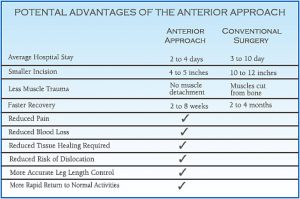
Since every hip exposure has specific pros and cons (see Figure 3.0), it is recommended to discuss your options with your surgeon. It is the job of the surgeon to match each individual patient’s need to the specific approach. Patients and surgeons want to minimize pain and speed recovery, yet the main objective of hip replacement is to provide patients with a well done operation, with good component position, and the expectation that it will last for the next 20 years.

Figure 3.0  Advantages associated with the anterior approach compared to conventional surgery.

Advancing Knee Surgery

Oro Valley Hospital is the first hospital in Southern Arizona to provide patients with a revolutionary surgeon-controlled robotic-assisted procedure for partial knee resurfacing.

The Rio Robotic Arm Interactive Orthopedic System allows surgeons to treat patient-specific knee conditions with a level of accuracy and precision not previously possible. Arizona now joins 35 states in the nation using MAKOplasty partial knee resurfacing technology.

For the patient, robotic surgery means nearly a third less time in the hospital and about half the recovery time.

According to the American Academy of Orthopedic Surgeons, knee replacement surgery has become one of the most successful of all joint replacement procedures in the country. The Agency for Healthcare Research & Quality reports that more than 600,000 knee surgeries are performed annually.

The knee is the largest joint in the body, located at the juncture of the femur, the tibia and patella. The femur and the tibia are connected by the anterior and posterior cruciate ligaments. During movement, the joint is cushioned by the meniscus, a tough cartilage material. The patella, or kneecap, is a small bone encased in tendons, that glides up and down in the groove on the top of the femur when the knee is flexed or extended. Where the femur meets the tibia, there is an inner (medial) and outer (lateral) compartment. The patella makes up the third compartment.

Previously, there was no way to repair a single compartment in the knee. When degeneration occurred, a total knee replacement was required.

With this new technology, surgeons can now conduct a minimally invasive procedure to remove early stages of osteoarthritis that have not yet reached all three compartments of the knee. Unlike other robotic systems, the Rio is controlled completely by the surgeon in the operating room, allowing for the greatest precision and saving as much of the knee and surrounding tissue as possible.

From a surgeon’s perspective, the robot provides for an increased level of accuracy,” said Dr. Kevin Bowers, an orthopedic surgeon who has performed nearly a half-dozen partial knee replacement procedures at Oro Valley Hospital. “The robot provides an element of control and an increased level of accuracy that is estimated at two to three times the traditional procedure. Getting that precise alignment can be the key to the longevity of the procedure. The robot’s biggest advantage is that level of accuracy.”

Bowers said he just saw his first patient at his two-week follow up and the patient came into the office without the use of any walking aids. “It’s doing what we expect it to be doing.”

Partial knee replacement procedures had been tried over the years, but with mixed and often disappointing results, Bowers said. “Partial knee replacement can be a little persnickety,” mostly because the ability to provide proper alignment among the three compartments, and to accurately remove degenerative tissue. About 10 years ago there was a revival in the interest in partial knee replacements as technological advances continue to drive research into ways of improving the ability to prolong joint and bone life, he said.

Partial knee resurfacing is not for everyone. Osteoarthritis must be in the early stages, and the procedure is not recommended for patients with inflammatory arthritis as that tends to extend to other parts of the body and caring for a joint at one source will unlikely solve the issue elsewhere.

There are two surgeons using the Rio system at Oro Valley Hospital – Dr. Bowers and Dr. James Benjamin. More orthopedic surgeons are seeking certification, but are not yet using the robot to perform surgeries on patients.

To find out if you are a candidate for this procedure, Oro Valley Hospital hosts free seminars.

To learn more, visit www.orovalleyhospital.com or call the seminar registration line at (866) 694-9355.

By Mary Minor Davis, September 15, 2012

Original source: https://biztucson.com

Advancing Knee Surgery

Oro Valley Hospital is the first hospital in Southern Arizona to provide patients with a revolutionary surgeon-controlled robotic-assisted procedure for partial knee resurfacing.

The Rio Robotic Arm Interactive Orthopedic System allows surgeons to treat patient-specific knee conditions with a level of accuracy and precision not previously possible. Arizona now joins 35 states in the nation using MAKOplasty partial knee resurfacing technology.

For the patient, robotic surgery means nearly a third less time in the hospital and about half the recovery time.

According to the American Academy of Orthopedic Surgeons, knee replacement surgery has become one of the most successful of all joint replacement procedures in the country. The Agency for Healthcare Research & Quality reports that more than 600,000 knee surgeries are performed annually.

The knee is the largest joint in the body, located at the juncture of the femur, the tibia and patella. The femur and the tibia are connected by the anterior and posterior cruciate ligaments. During movement, the joint is cushioned by the meniscus, a tough cartilage material. The patella, or kneecap, is a small bone encased in tendons, that glides up and down in the groove on the top of the femur when the knee is flexed or extended. Where the femur meets the tibia, there is an inner (medial) and outer (lateral) compartment. The patella makes up the third compartment.

Previously, there was no way to repair a single compartment in the knee. When degeneration occurred, a total knee replacement was required.

With this new technology, surgeons can now conduct a minimally invasive procedure to remove early stages of osteoarthritis that have not yet reached all three compartments of the knee. Unlike other robotic systems, the Rio is controlled completely by the surgeon in the operating room, allowing for the greatest precision and saving as much of the knee and surrounding tissue as possible.

From a surgeon’s perspective, the robot provides for an increased level of accuracy,” said Dr. Kevin Bowers, an orthopedic surgeon who has performed nearly a half-dozen partial knee replacement procedures at Oro Valley Hospital. “The robot provides an element of control and an increased level of accuracy that is estimated at two to three times the traditional procedure. Getting that precise alignment can be the key to the longevity of the procedure. The robot’s biggest advantage is that level of accuracy.”

Bowers said he just saw his first patient at his two-week follow up and the patient came into the office without the use of any walking aids. “It’s doing what we expect it to be doing.”

Partial knee replacement procedures had been tried over the years, but with mixed and often disappointing results, Bowers said. “Partial knee replacement can be a little persnickety,” mostly because the ability to provide proper alignment among the three compartments, and to accurately remove degenerative tissue. About 10 years ago there was a revival in the interest in partial knee replacements as technological advances continue to drive research into ways of improving the ability to prolong joint and bone life, he said.

Partial knee resurfacing is not for everyone. Osteoarthritis must be in the early stages, and the procedure is not recommended for patients with inflammatory arthritis as that tends to extend to other parts of the body and caring for a joint at one source will unlikely solve the issue elsewhere.

There are two surgeons using the Rio system at Oro Valley Hospital – Dr. Bowers and Dr. James Benjamin. More orthopedic surgeons are seeking certification, but are not yet using the robot to perform surgeries on patients.

To find out if you are a candidate for this procedure, Oro Valley Hospital hosts free seminars.

To learn more, visit www.orovalleyhospital.com or call the seminar registration line at (866) 694-9355.

By Mary Minor Davis, September 15, 2012

Original source: https://biztucson.com

Search

+